Nobody teaches a girl in a government school how to throw a punch. She is taught to be polite, to adjust, to walk in groups, and to come home before dark. She is given advice dressed as protection and caution dressed as care. What she is rarely given is permission to hit back.
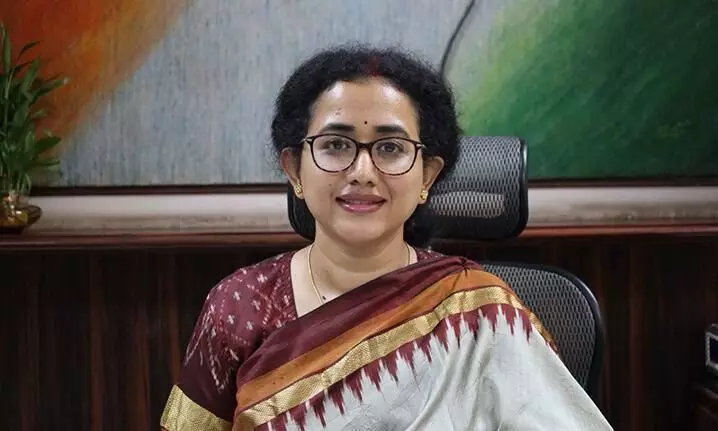
In November 2025, in the sun-scorched training grounds of Dhule, a District Collector decided to change that equation for good. Bhagyashree Vispute, the Collector of Dhule, assembled 10,500 girl students from every corner of the district—across every board, medium of instruction, and taluka—and put them through three days of intensive, ground-level self-defence training under the banner of a single word: Veerangana.
It was not a seminar. It was not a rally. It was a physical, sweating, shouting, striking programme designed to lodge one idea permanently into the body of every participant: you are allowed to defend yourself, and here is exactly how.
The Problem She Refused to Ignore
Dhule stretches across the northern rim of Maharashtra, where the Satpura range meets the Tapi basin. Its villages are scattered, its roads long, and transport is limited. Thousands of girls travel solitary routes every morning to reach schools and junior colleges and return the same way after dusk.
For years, the administrative response to this reality followed a familiar template: awareness camps, guest lectures, printed leaflets, speeches on Women’s Day, and then a file closed until the next calendar event.
Bhagyashree looked at that template and rejected it.
Awareness without ability, she reasoned, is decoration. A girl who has been told to dial a helpline is not the same as a girl who has been taught to break a wrist grip in two seconds. The former depends on a phone, a signal, and a stranger picking up. The latter depends on nothing but her own trained reflex.
“This initiative is about building knowledge, self-awareness and inner strength in our girl students. Every department of the district administration has worked as one team to make it possible. The skills our daughters have learned will stay with them for the rest of their lives,” she says.
Two Phases, One Permanent System
The design of Veerangana reveals the administrative mind behind it.
Before a single student was called to the training ground, Bhagyashree ran a two-day Train the Trainer programme. Around 250 local trainers from across Dhule were selected and certified, creating a standing cadre that would remain in the district long after the camp ended.
This was the structural move that separated Veerangana from one-off safety events. The camp was temporary. The cadre was not.
In the second phase, the 10,500 students arrived. Leading the training on the ground was Shifuji Shaurya Bhardwaj, the architect of the Mission Prahar movement. His methods focused on techniques built for real-life situations young women face: unlit roads, crowded buses, and sudden physical threats.
Every drill was designed around one truth: a girl who has rehearsed her response is less likely to freeze when the moment comes.
The Invisible Labour of Coordination
Gathering 10,500 students across three days in a geographically dispersed district like Dhule was no logistical footnote.
Education, Police, Women and Child Development, Health, Tribal Welfare, transport, venue management, food, water, and parental permissions—every department had to function in sync. A delayed bus fleet, missing permissions, or absent medical support could have derailed the operation.
Bhagyashree personally coordinated the effort, holding departments to a compressed timeline. Officers described it as one of the tightest multi-departmental operations they had witnessed at the district level.
Her governance style reflects earlier roles—from working with tribal communities in remote hamlets of Yavatmal to leading grassroots rural development efforts in Buldhana. Dhule is simply the latest example of the same instinct: show up, hold the line, and leave behind a system.
Beyond the Numbers
Statistics record that 10,500 girls were trained and 250 trainers certified. Statistics do not record the father from Shirpur watching his daughter practise a palm strike in silence. They do not record the trainer who returned to her village school and began teaching Class 8 students independently. Nor do they capture the shift in posture, confidence, and eye contact that instructors observed by the third day.
Veerangana is already replicating itself. Trainers are teaching. Students are practising. The model can be adopted by any district willing to prioritise action over ceremony.
A Different Kind of Answer
India has no shortage of speeches about protecting daughters. It has a severe shortage of programmes that give them the physical ability to protect themselves.
That gap, between rhetoric and reflex, is precisely the space Bhagyashree Vispute chose to address. Not with a louder slogan, but with 10,500 girls standing on their feet, fists raised, learning that the safest pair of hands they may ever rely on is their own.
For the daughters of Dhule, Veerangana is no longer just a word from history. It is memory stored in muscle and instinct. And that is something no one can take away.